When movement helps
Shorter learning blocks, movement breaks and practical tasks can support focus without lowering expectations.
Home education for neurodivergent learners
Neurodivergent children can learn in very different ways. That’s why we don’t start with a label. We start with your child.
Apply-ED creates curriculum-aligned home education programs shaped around their strengths, interests, learning preferences and individual needs.
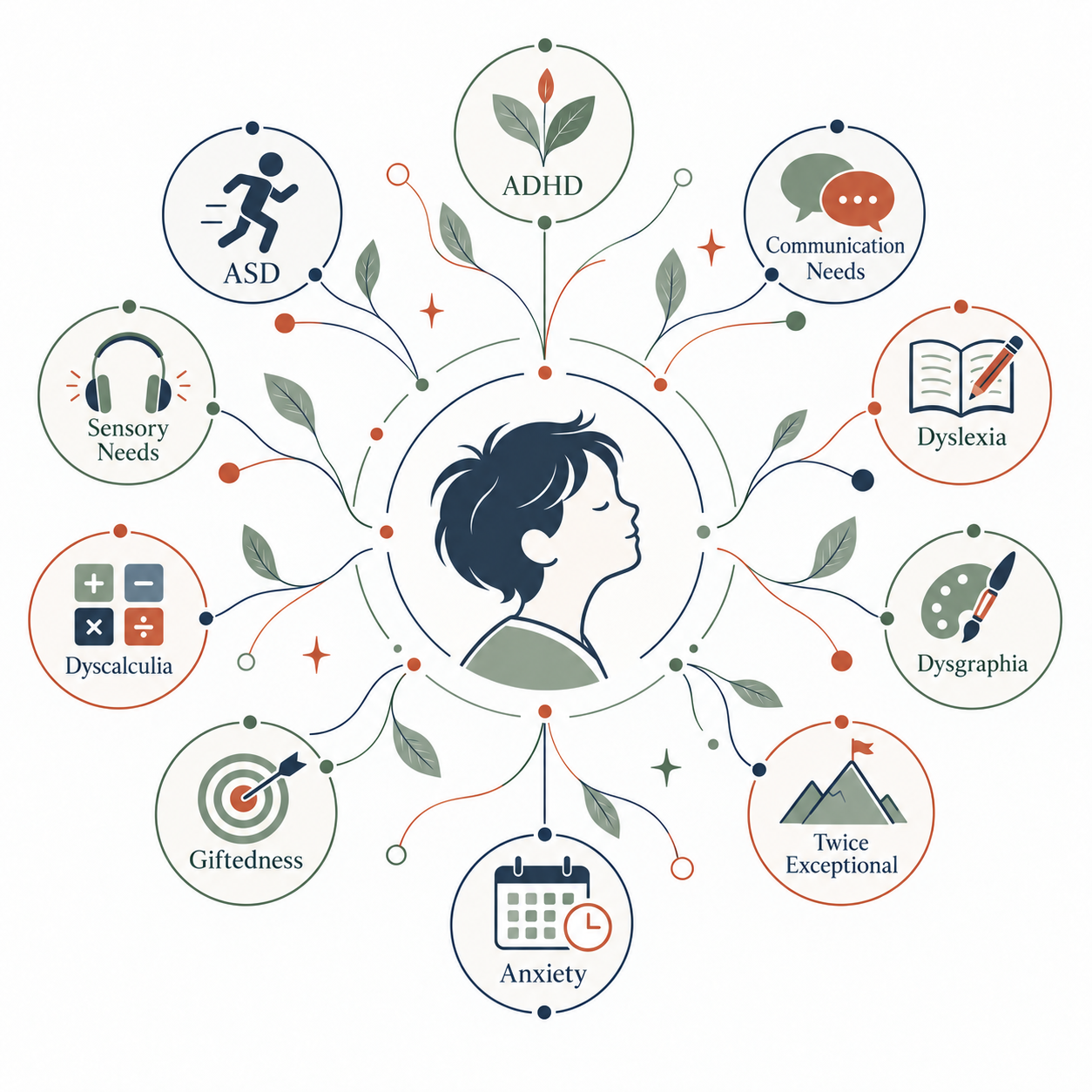
BUILT AROUND THE INDIVIDUAL
Two children can share the same diagnosis and still learn in completely different ways. A label can give us context, but it can’t tell us how your child learns best.
Different strengths. Different supports. Different pathways.
That’s where you come in.
You tell us what helps them engage, what gets in the way and what lights them up.
We build from there.
No formal diagnosis required.
WHAT IT LOOKS LIKE IN PRACTICE
The difference is in the detail: how tasks are structured, how understanding can be shown, and what helps a child engage.
Shorter learning blocks, movement breaks and practical tasks can support focus without lowering expectations.
A child may understand far more than they can comfortably put on paper. Oral responses, visual planning, technology and multimodal tasks can help them show what they know while still building writing skills.
Clear steps, consistent routines and advance notice of transitions can make learning easier to enter, follow and complete.
Understanding does not have to be shown through speech alone. Learning can include visual choices, gesture, augmentative and alternative communication (AAC) and other appropriate ways to communicate.
Dinosaurs. Trains. Space. Minecraft. Ancient Egypt. A strong interest can become the way into English, Mathematics, Science, Humanities and more.
A child can be years ahead in one area and need significant support in another. The program should reflect both, without assuming every skill develops at the same pace.
Three learners. Three approaches.
The curriculum can stay the same while the way a child learns it changes completely.
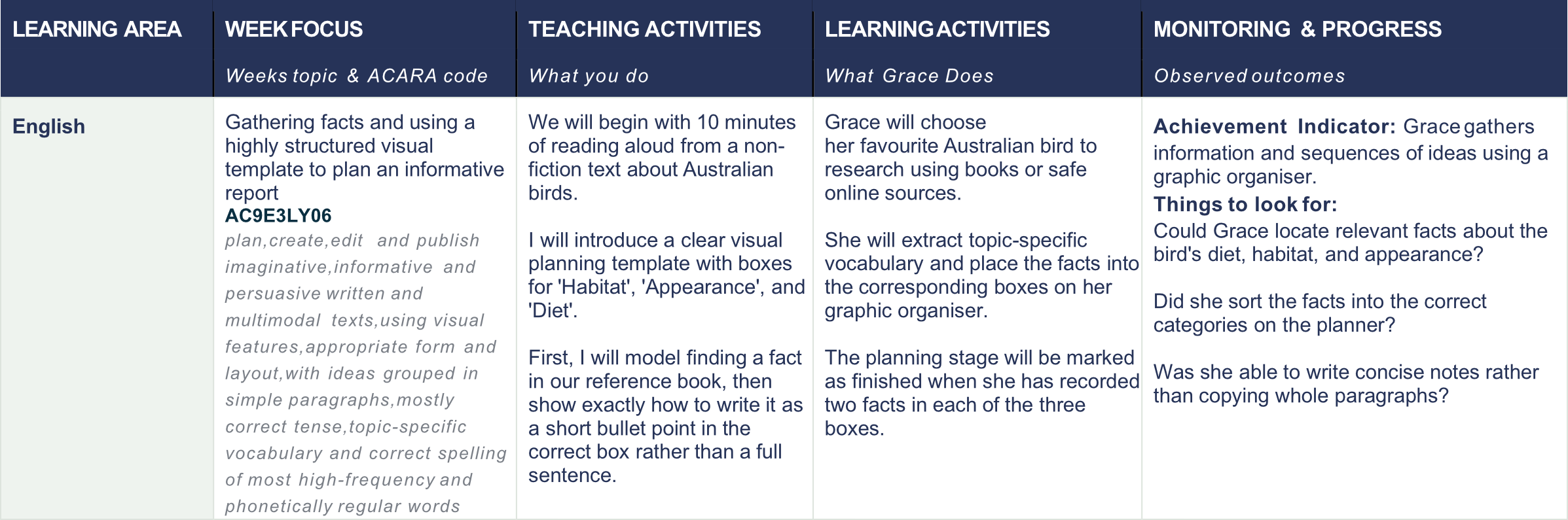
Grace works with a structured visual template and a topic she knows well. The curriculum stays aligned, while the structure around the task reduces unnecessary uncertainty.
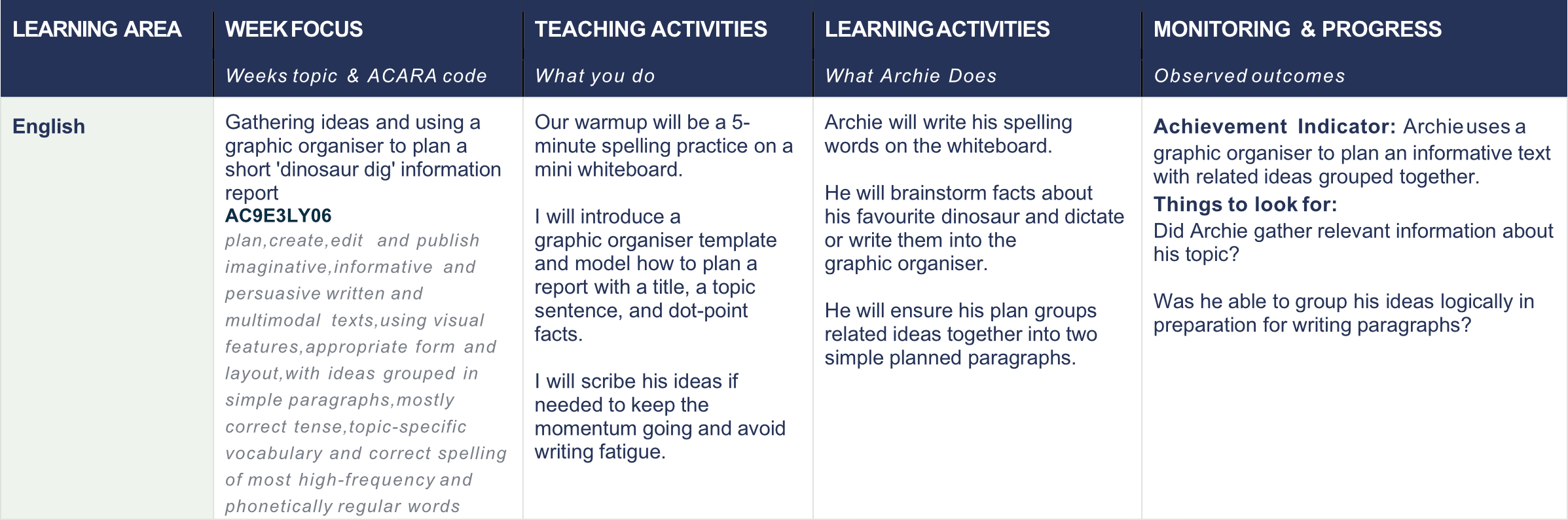
Archie works in shorter activity blocks, uses a strong interest to anchor the task and can dictate ideas before organising them into written form.
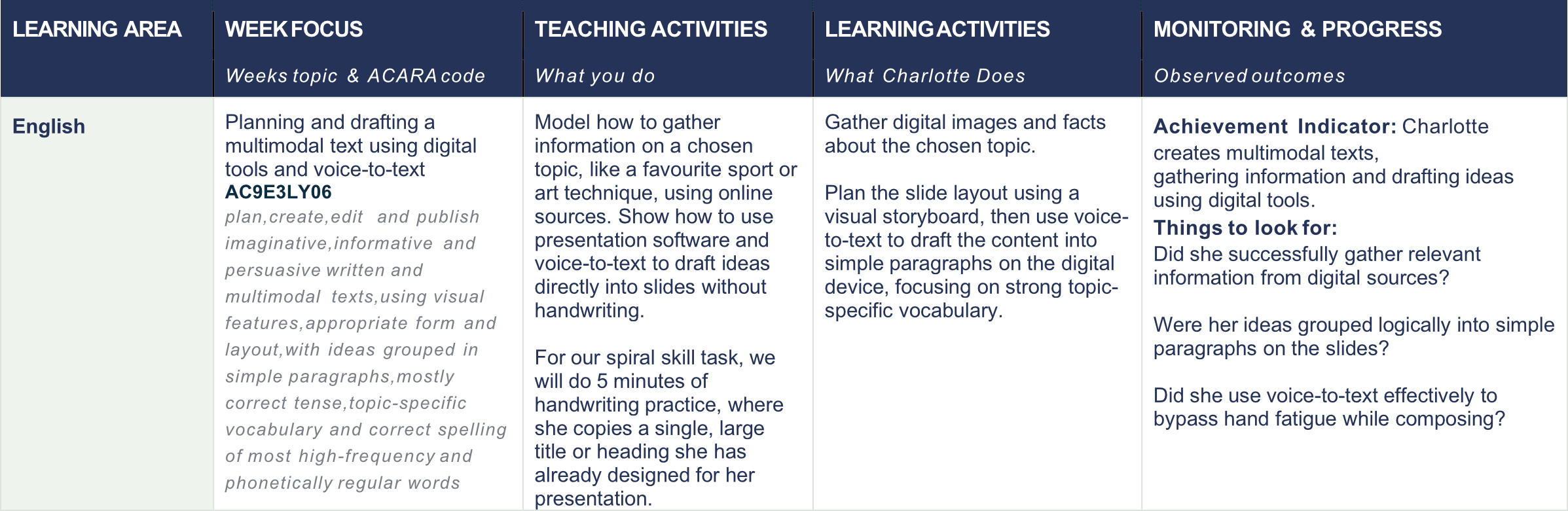
Charlotte plans visually and can use tools such as voice-to-text so the physical demands of writing do not prevent her from developing and communicating her ideas.
Real program example
Year 5 · ADHD · ASD · Dysgraphia
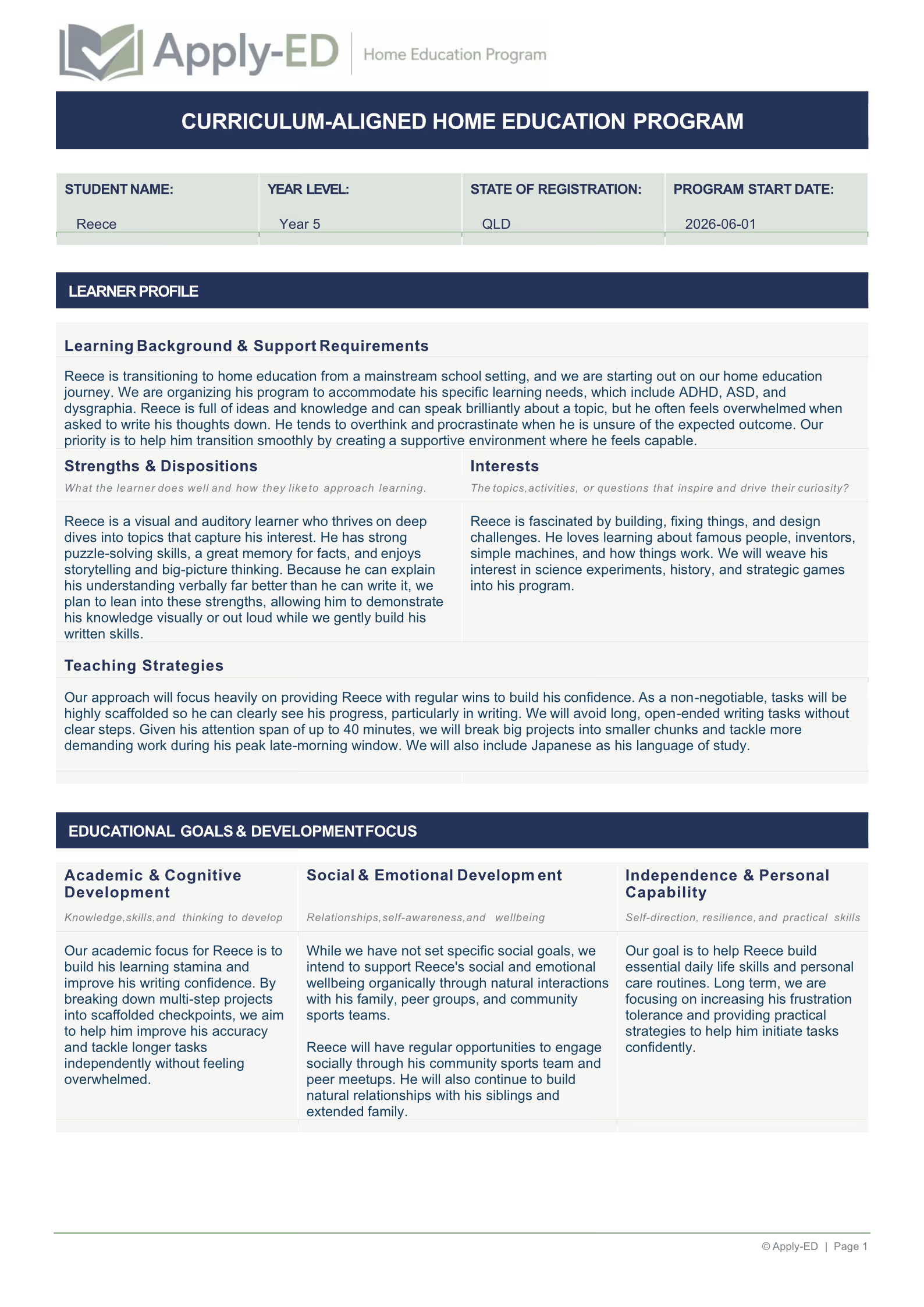
Reece is full of ideas and loves diving deeply into facts, history and how things work. Getting those ideas onto paper and managing longer, multi-step tasks can be harder.
His program uses his interests to draw him into the learning, scaffolds written work and breaks larger tasks into manageable steps. His family’s goals around writing confidence, focus and growing independence are built through the program.
The curriculum stays aligned to his year level, with all eight learning areas adapted to the way he learns.
Reece is an illustrative learner profile. Your child’s program is created from the information you provide about them.
FROM INTAKE TO PROGRAM
Complete the guided intake and tell us what engages your child, where their strengths lie, what gets in the way and what matters to your family.
We’ll use that to build the program around them.