PERSONALISED.
REALLY.

Same goal. Five different children.
Five different plans.

Most 'personalised' plans aren't.

A name swapped into a template isn't personalised.
A cover page change isn't personalised.
A generic plan written for the typical child isn't personalised.
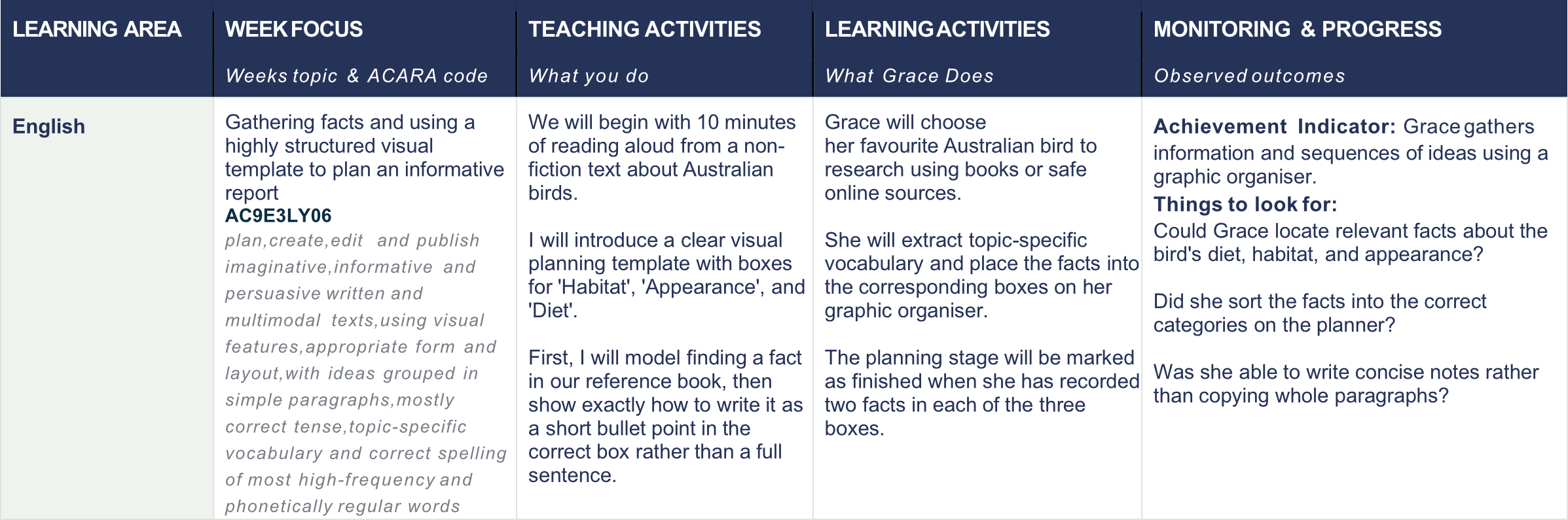
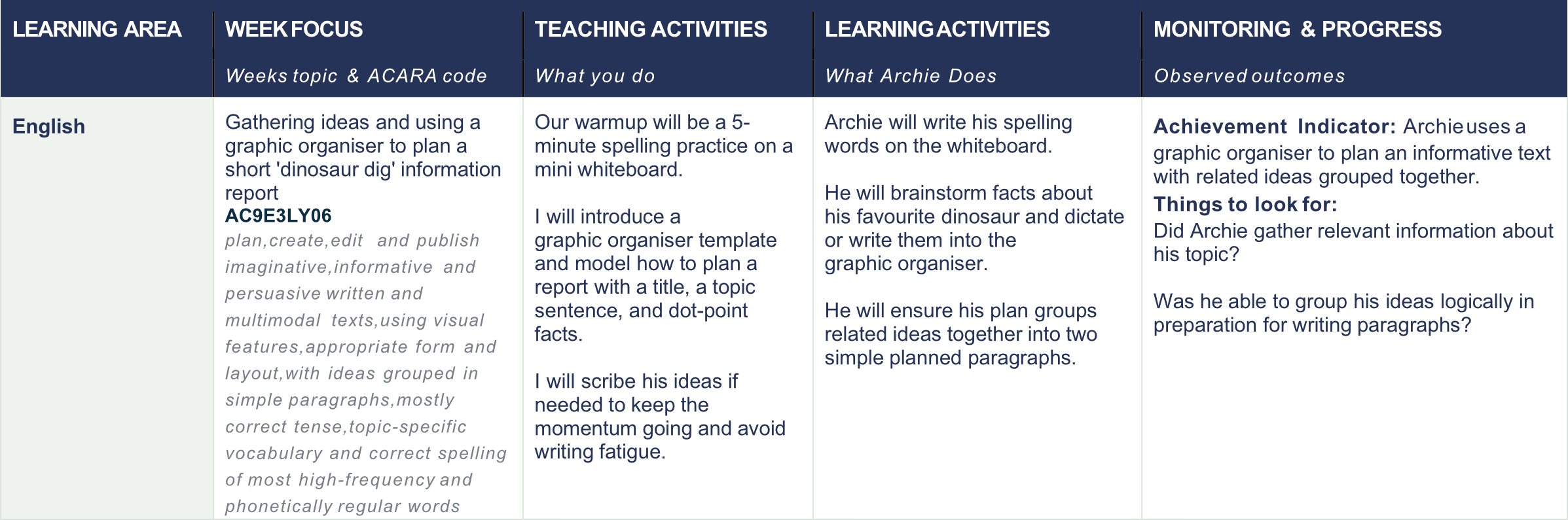
Personalised means written for your child. Not the average one.

here's the magic

One Year 3 English goal. Five different children.

Grace
the asd learner
We use predictable structure and clear systems. Each session starts with the same sequence, transitions are signalled explicitly, and every task has a defined starting point and a clear 'finished' line. Where their special interests fit naturally into the work, we use them as part of how the task is built, not as decoration on top.
Predictable structure → Explicit signals → Defined endings → Interests as scaffolding.
Archie
the ADHD learner
Activity bursts stay short (10 to 15 minutes). We add a timer for urgency, gamify for challenge, vary the format or medium for novelty (draw it, build it, act it out), and anchor the work in their hobbies and passions for interest. The brain that schools called distractible is the same brain that thrives when the right four levers are pulled.
Short bursts → Interest → Challenge → Novelty → Urgency.
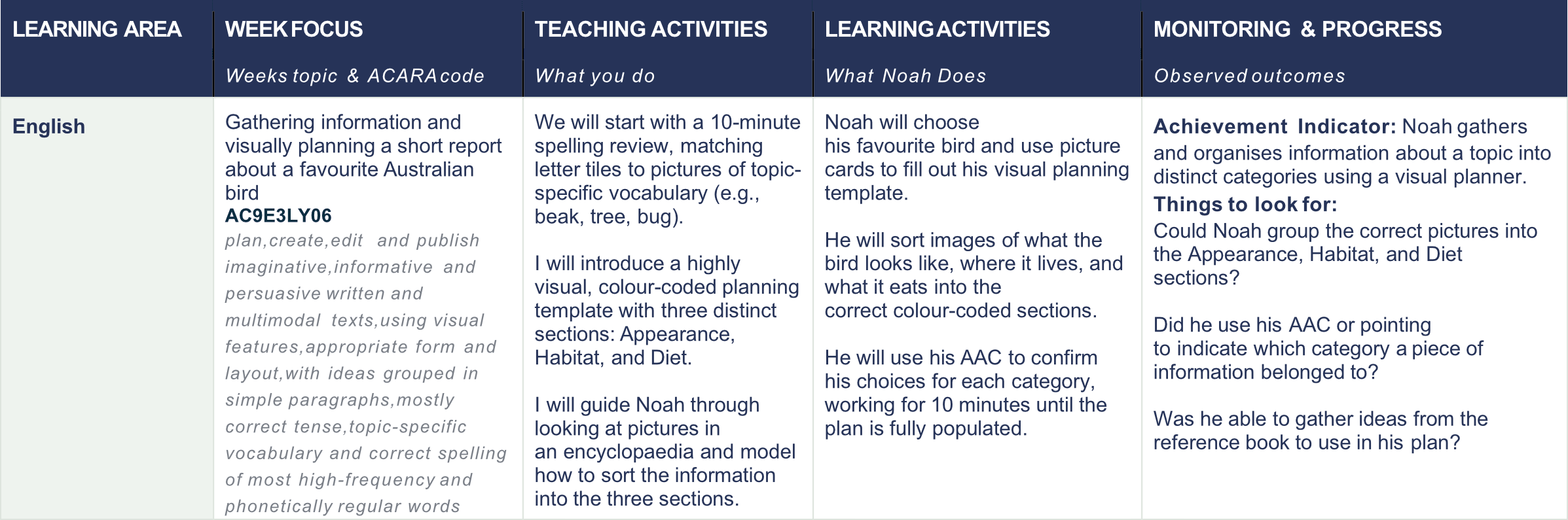
Noah
the non-verbal learner
We presume competence. The non-verbal learner understands more than they can speak, so we never simplify the content, only the response format. Spoken-output tasks are replaced with point-to-answer, multiple choice, drawing, gesture, or Augmentative & Alternative Communication (ACC). For discussions, they participate by selecting or signing. AAC vocabulary is modelled alongside their own speech, and every task is framed so their AAC system can be used directly.
Full content, adapted output → AAC-integrated tasks → Response by selection, gesture, or device.
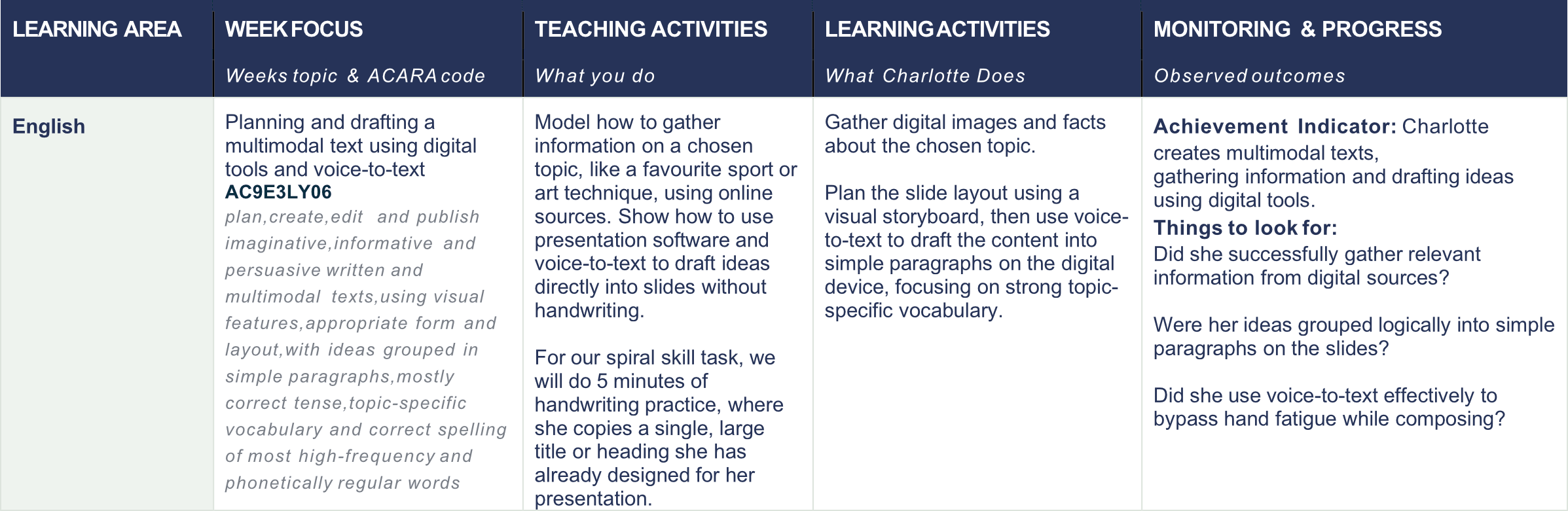
Charlotte
the dyslexic & dysgraphic learner
We use Bypass and Scaffold. Handwriting and decoding shouldn't bottleneck their thinking so voice-to-text, dictation, typing and graphic organisers are routine. Writing tasks isolate one skill at a time, ideation OR mechanics, never both at once. Their ideas come first; the writing tools follow.
Bypass the bottleneck → Scaffold the format → Isolate one skill at a time.
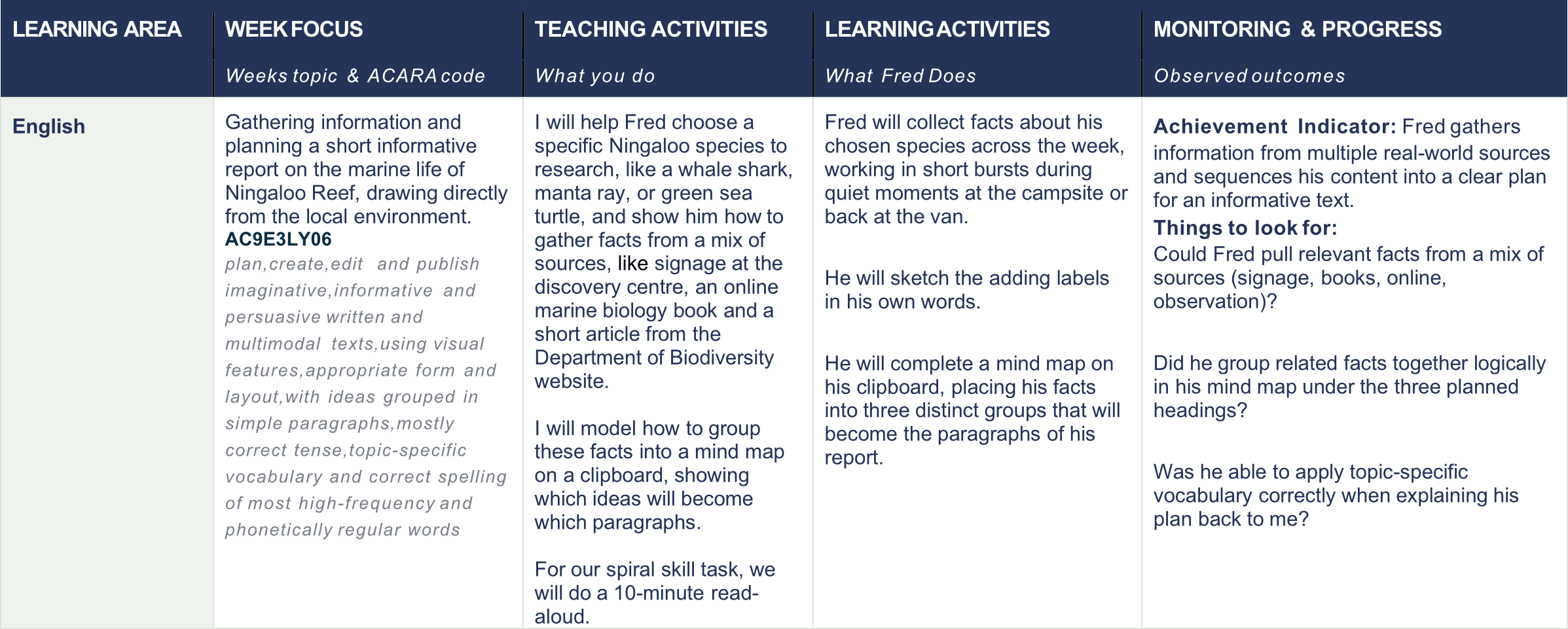
Fred
the travelling learner
We use the world as the classroom. The travelling learners curriculum draws from where they actually are, real signage, local libraries, the museums and visitor centres along the way, the wildlife outside the van. Learning happens in short bursts that fit a travelling rhythm: at the picnic table, in the back seat, at the campsite. The audience for their work is real (a campsite review, an email to a park ranger, a family travel blog), and the curriculum requirements are met through the world they're already exploring.
Real sources → Real audiences → Travelling rhythm → Curriculum met through place.

how it begins

We start by getting to know your child.

Not their year level. Not their diagnosis. Your child.

Real questions about your child.
Our intake asks the kind of questions a template never thinks to ask, how your child shows they're overwhelmed, what they avoid, what they devour, how they actually learn.
A plan built around your answers.
Your intake answers shape every part of the plan, the activities, the pacing, the topics, the way each task is set up.
A plan you actually use.
Yours as an editable document. The big-picture overview, the weekly plan, ready for the kitchen table from day one.

Learning differences are part of the design,
not an exception to it.

Apply-ED works with how your child actually learns, including ADHD, autism, dyslexia, dysgraphia, dyscalculia, anxiety, sensory processing differences, gifted and twice-exceptional learners,  and other specific needs your intake captures.

Apply-ED works with how your child actually learns, including ADHD, autism, dyslexia, dysgraphia, dyscalculia, anxiety, sensory processing differences, gifted and twice-exceptional learners,  and other specific needs your intake captures.

We're not clinicians and we don't claim specialist accreditation. What we do is build the program around the child your intake describes, including the parts of how they learn that a one-size-fits-all template can't accommodate.

Here's what that looks like for a real Apply-ED family.

Sample Program - Upper primary

Meet Reece - Year 5

Reece is full of brilliant ideas and loves diving deep into facts, history, and how things work. Diagnosed with ADHD, ASD and Dysgraphia, he often finds it challenging to get those big ideas onto paper or stay focused when managing a multi-step project. As he navigates upper primary, his parents want to focus on building his academic stamina, supporting his unique learning needs, and helping him take charge of his daily routines.

Reece's program shows how the Apply-ED model takes shape for an upper-primary learner with specific goals and specific learning needs. Curriculum coverage stays the same, every Year 5 child works across all eight learning areas. What changes is how it's delivered: parent and student goals like building writing confidence, managing focus, and growing independence are woven through every study block, with teaching strategies and pacing tailored to how Reece's brain actually works.
read reece's full program sample

reece's year 5 blueprint

Academic focus,
building independence.

Student level:
Upper Primary (Year 5)
learner profile:
Big thinker, working on academic confidence and self-direction
Curriculum:
Aligned to your state curriculum
Learning areas:
All core learning areas
structure:
Yearly overview, 4 study blocks
Pacing:
Parent-directed with growing student independence
Review:
Human-reviewed

Ready to start?

Begin with the guided intake, or browse sample programs to see what yours could look like.

create program
Please select your state above to continue.

No obligation. No submission on your behalf. Final submission always remains parent-led.

get started

Ready to create your home education program?
Start with a short guided intake. We’ll generate a structured, personalised program you can review, refine and submit when you’re ready.
create program
Please select your state above to continue.

No obligation. No submission on your behalf.