There is a word that gets thrown around a lot in home education:
Often, it just means a standard template with a child's name typed into a box at the top. But a name swapped into a generic document isn't personalisation. Templates, by their nature, are built for an imaginary "average" child who doesn't actually exist.
So today, we want to show you exactly what we mean when we say personalised. Not as a slogan. As a demonstration.
Here's what we did. We took one goal from the Year 3 Australian Curriculum.
AC9E3LY06:
Plan, create, edit and publish imaginative, informative and persuasive written and multimodal texts, using visual features, appropriate form and layout, with ideas grouped in simple paragraphs, mostly correct tense, topic-specific vocabulary and correct spelling of most high-frequency and phonetically regular words.
It is a perfectly ordinary curriculum requirement. On a generic template, it would get a tidy paragraph of instructions, the exact same for every child.
We wrote it five different ways, for five very different learners. Same outcome. Same ACARA code. Five completely different pathways.
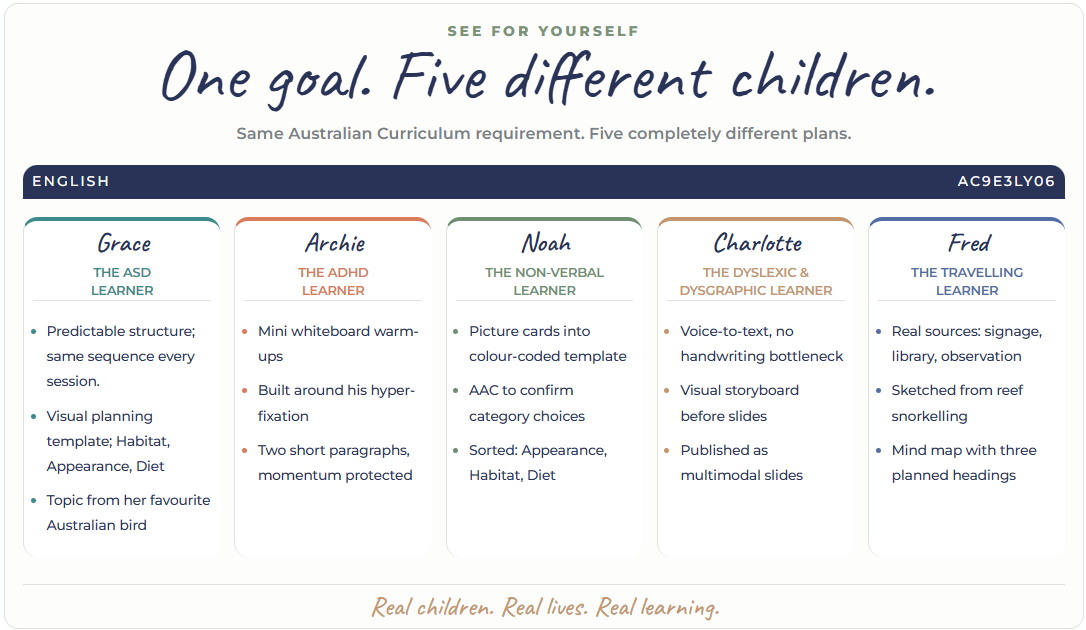
Look at that for a moment. Really look at it.
Every one of those children is meeting the same Australian Curriculum requirement. But the way they get there, the materials, the activities, and the way they show their learning, all of it changes to fit them.
These aren't just minor accommodations bolted onto a default plan. Each pathway is designed around how the child in front of us actually learns:
Predictable structure → Explicit signals → Defined endings → Interests as scaffolding.
Open-ended writing prompts can cause real anxiety. So, Grace's plan relies on predictable structure. Transitions are explicitly signalled, and every task has a defined finish line. She researches her favourite Australian bird and uses a highly structured visual template to organise her facts. The structure is the support.
.png)
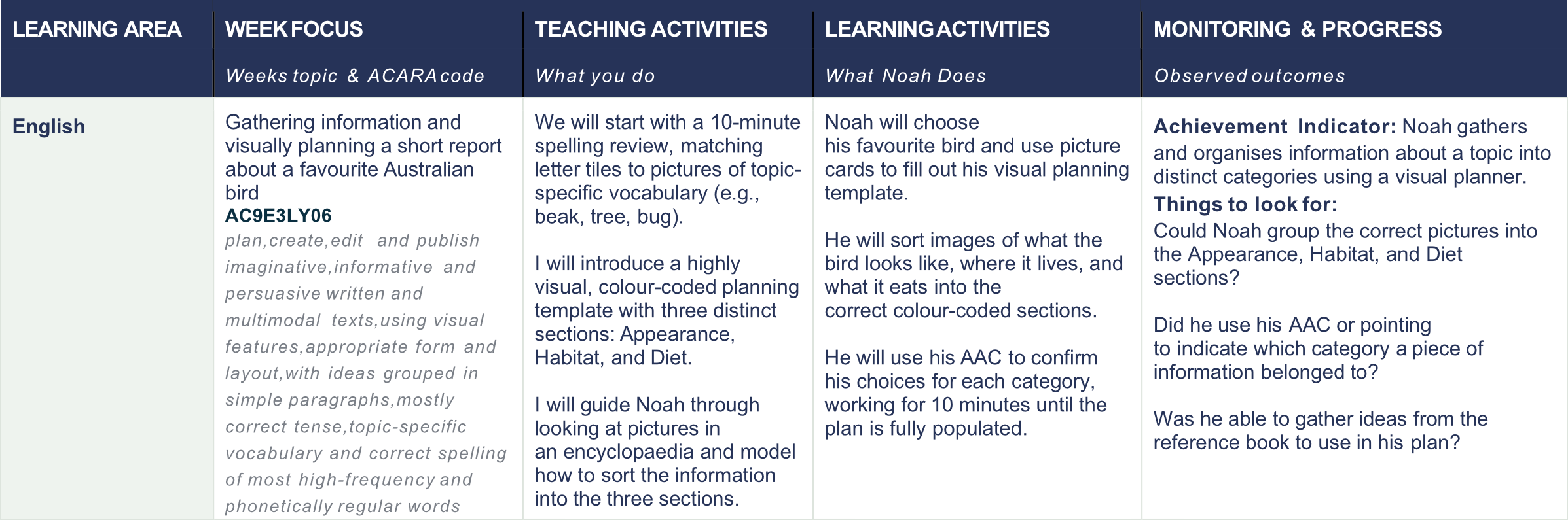
Short bursts → Interest → Challenge → Novelty → Urgency.
Sitting still to draft a paragraph is a roadblock, so we don’t ask him to. Activity bursts stay short (10–15 minutes). A timer adds urgency, and the work is anchored in his hyper-fixation on dinosaurs. He dictates his facts into a graphic organiser to protect his momentum and avoid writing fatigue.
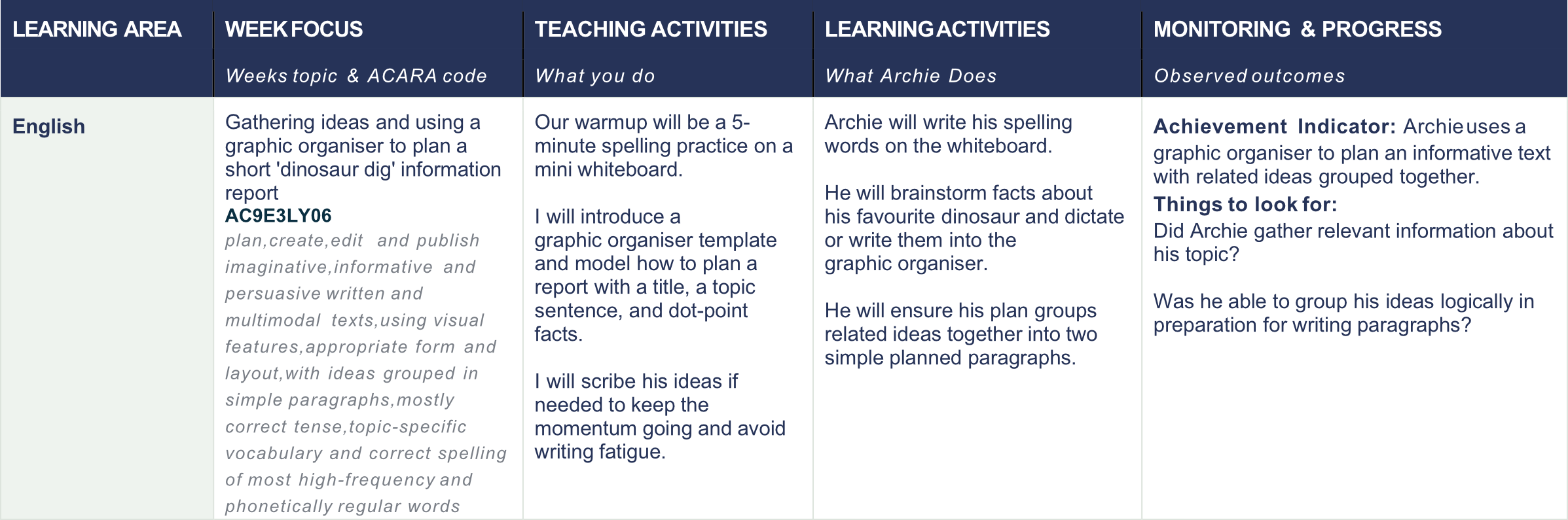
Full content, adapted output → AAC-integrated tasks → Response by selection, gesture, or device.
We presume competence. Noah understands more than he can speak, so we never simplify the content, only the response format. He sorts picture cards into a colour-coded visual planning template and confirms his choices with his AAC device. The composition is real. The pathway is his.
Bypass the bottleneck → Scaffold the format → Isolate one skill at a time.
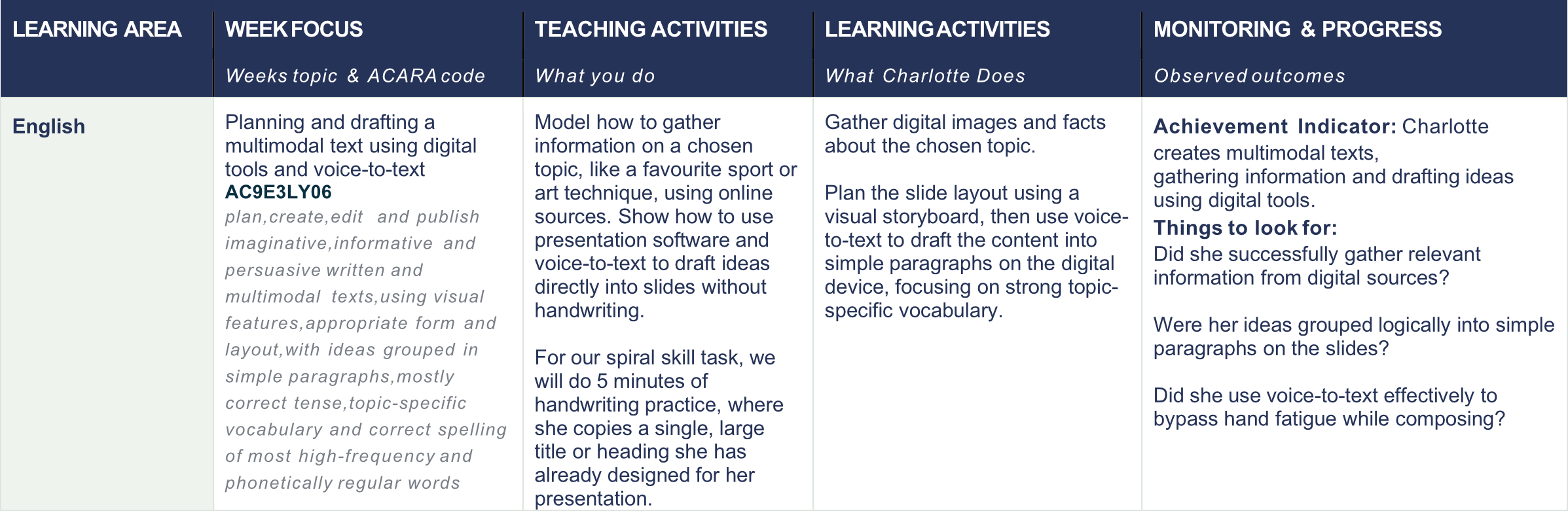
The standard pathway secretly tests handwriting and decoding, not actual composition. Charlotte's plan separates the skill from the obstacle. She plans her text on a visual storyboard, then drafts directly into slides using voice-to-text. Her ideas come first; the writing tools follow.
Real sources → Real audiences → Travelling rhythm → Curriculum met through place.
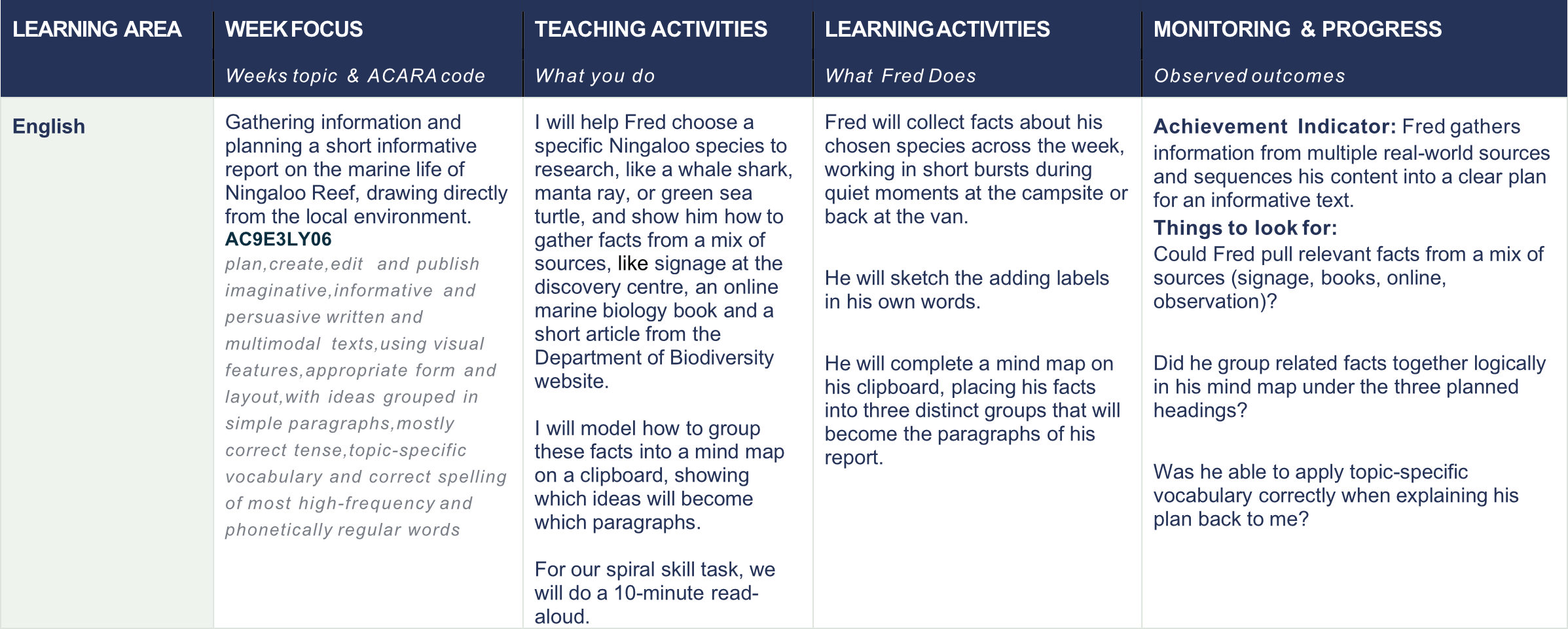
A workbook isn't required when the world is the classroom. Fred draws from real signage, visitor centres, and the wildlife outside the van. He collects facts about the Ningaloo Reef in short bursts, sketching and labelling in his own words on a clipboard. The curriculum is met through the world he is already exploring.
There is no shortcut here. No skipping the goal. Every child does the work and hits the curriculum standard, they just do it in a way that matches their brain.
That is what personalisation means. It is sitting with the question, "How does this particular child learn?" and writing the curriculum to fit the answer.
If you've been holding the weight of your child's educational differences on your own, and the thought of standard homeschooling registration paperwork feels impossible, please hear this: You already have the most important piece of the puzzle.
You know your child. You know what overwhelms them and what lights them up.
At Apply-ED, we take your knowledge and turn it into a genuine, fully customized home education program. Not a template. A plan written specifically for the kitchen table reality of your home.
The example above is just a single goal. The full plans we write run to forty pages or more, with the same level of care extended across every learning area, every term.
We've put four real, complete sample plans on our website so you can see exactly what that looks like in practice. No watermarks. No hidden pages. Just real learning.
Mid-year is our busiest window, and plans are delivered in two business days, so earlier is better!
No obligation. No submission on your behalf.