You've made the decision, or you're seriously thinking about it, to home educate your child. And then someone mentioned a "home education program," and suddenly the warm, child-led future you'd been picturing collided with a wall of paperwork.
Take a breath. You're not alone in finding this part the most intimidating, and the good news is it's not nearly as complicated as it first appears.
You may have also seen it called an "educational plan," a "learning plan," or a "curriculum program." Different states use slightly different terms, but they all mean essentially the same thing: a document that describes how you're going to educate your child at home.
This guide explains what a home education program is, why you need one, what to include, and how to put one together that meets your state's registration requirements, without losing your weekends to it.
A home education program is a written document that outlines what your child will learn, how they'll learn it, and what resources you'll use. It's the core document you submit as part of your registration for home education.
Think of it as a roadmap for your child's learning year. It doesn't need to script every single day, it just needs to show that you've thought carefully about your child's education and that you can cover the key learning areas in a way that suits them.
Every state and territory in Australia requires some form of education program as part of the registration process, though the level of detail and format varies.
When you register for home education, you're asking your state's education authority to approve you as your child's educator. The education program is how you demonstrate that:
It's not about proving you're a qualified teacher, you don't need to be. It's about showing that you've done the thinking and planning to provide a genuine, well-rounded education.
There's also a practical reason that often gets overlooked: a good program gives you a roadmap. Without one, it's easy to drift, second-guess yourself, or end the year wondering whether you actually covered what you intended to. With one, you wake up on a Monday morning knowing what you're working toward.
While each state has its own registration body and requirements, the common elements across Australia are remarkably similar. Here's what virtually every education program needs to cover
Your program needs to show how you'll cover the eight key learning areas based on the Australian Curriculum (ACARA):
Here's the thing most parents don't realise: you don't need to teach these as separate "subjects." Many families blend them together naturally. A single cooking project, for example, covers Maths (measurement), Science (chemical changes), HPE (nutrition), and English (reading recipes).
One activity. Four learning areas. That's the beauty of home education.
Your program should describe how your child will learn. This is where you explain your teaching philosophy or approach. There's no single right answer, families successfully register with all kinds of methods:
There's no single right way. What matters is that you can explain your approach clearly and show how it covers the required learning areas.
Be specific about what you'll use. Vague statements like "we'll cover maths" aren't enough. Instead, name your resources:
You don't need expensive resources. Many families use a mix of free online content, library books, and everyday activities. What matters is that you've thought about it and can name specific things.
Every state wants to know how you'll keep track of your child's progress. Common recording methods include:
You don't need to use all of these, pick the methods that work for your family and mention them in your program.
This is where your program becomes personal. The education authority wants to see that you know your child and have tailored the program to them specifically. Consider including:
This is one of the most common questions, and the honest answer is: it depends on your state.
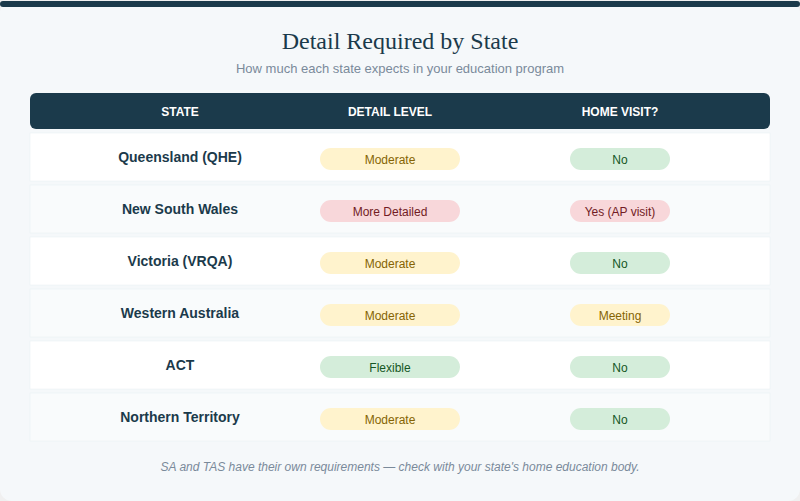
The general rule: more detail is rarely a problem, but vague or generic programs almost always are. NSW tends to expect the most thorough documentation, while ACT is the most flexible. Wherever you're applying, a clear, specific, well-structured program will serve you well.
These are the most common reasons education programs get sent back for revision.
Most rejections aren't about the family's ability to educate, they're about the program not clearly showing what the family already knows.
Writing your education program is the part of registration that causes the most stress for parents. You want to get it right, but you're not sure what the education authority is actually looking for. The paperwork shouldn't be the thing that stops you from giving your child the education they need.
Apply-ED takes the guesswork out of it. Our programs are built on the Australian Curriculum (ACARA v9.0), which forms the foundation of state curricula across Australia. When you create your program through Apply-ED, you'll receive:
Everything you need to home educate with confidence and tick the registration box too.
Your program should reflect who your child is. Real children. Real lives. Real learning.
Have questions about home education registration? We'd love to help, drop us a line at admin@apply-ed.com.au or send us a message on Instagram.
— Sam, Apply-ED.
No obligation. No submission on your behalf.